How to Manage Conflict Between Two Employees (Without Creating More Risk)
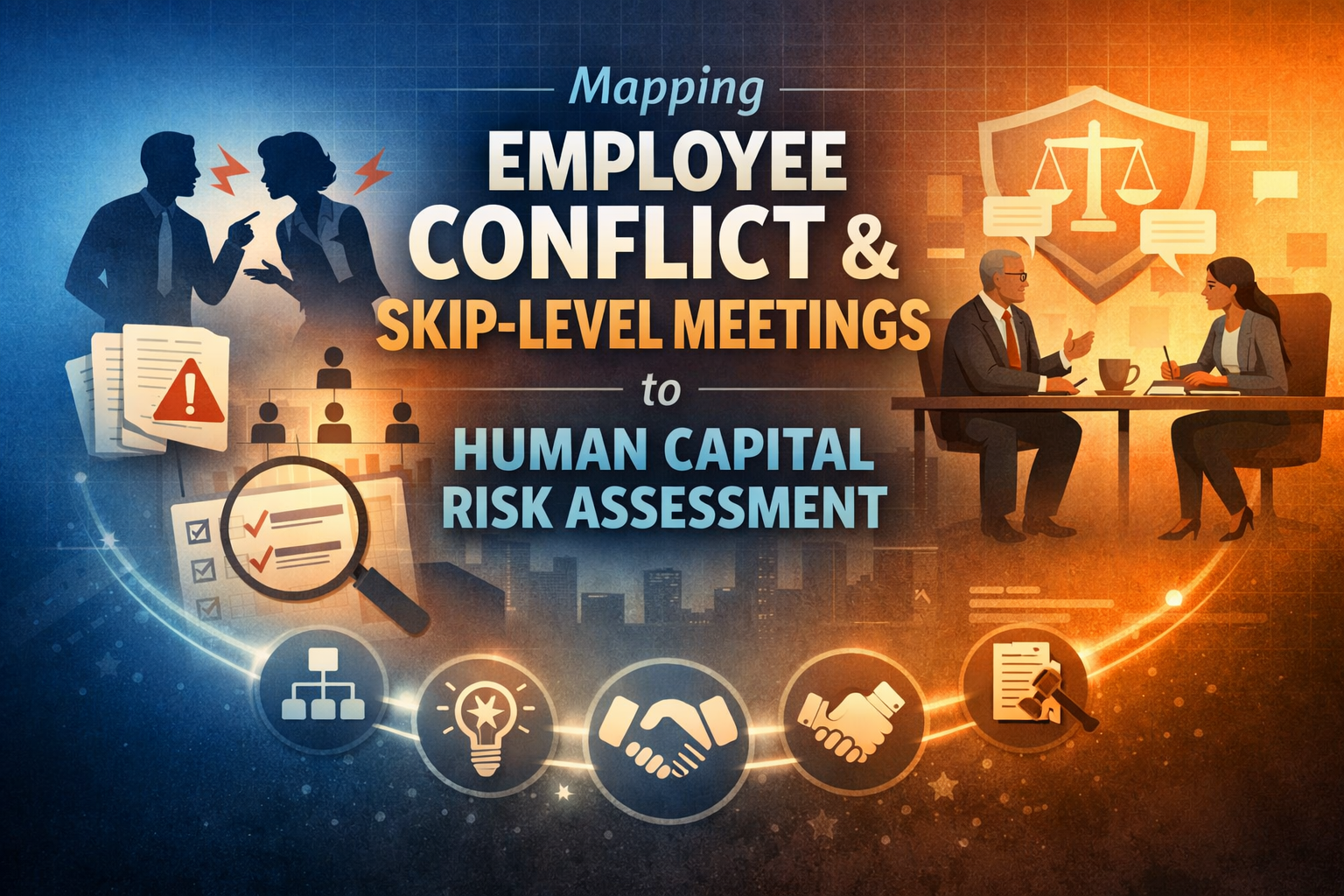
Illustration showing two employees in conflict on one side and a senior leader holding a structured skip-level meeting on the other, representing how employee conflict and skip-level meetings are used within a human capital risk assessment framework to improve clarity, trust, and organizational stability.
Short Answer
Employee conflict should be addressed early, neutrally, and with structure.
The goal is not to determine who is “right,” but to stabilize operations, protect trust, and prevent escalation into performance, legal, or cultural risk.
Unmanaged conflict rarely resolves itself. It compounds.
Why Employee Conflict Becomes a Business Risk
Conflict between two employees is often misclassified as a “people issue.” In reality, it is an operational risk signal.
When conflict is ignored or mishandled, organizations experience:
Productivity decline and role overlap
Communication breakdowns across teams
Manager avoidance or favoritism claims
Increased turnover or quiet quitting
Exposure to harassment, retaliation, or wrongful termination claims
Most conflicts do not start as misconduct. They become misconduct through delay, ambiguity, or poor leadership response.
The Framework: Structured Conflict Management
This approach is grounded in a Human Capital Risk Assessment framework, not mediation theatrics or informal coaching alone.
Step 1: Stabilize the Environment First
Before addressing the individuals, stabilize the work environment.
This means:
Clarifying reporting lines and decision authority
Removing immediate friction points (shared approvals, overlapping ownership)
Resetting expectations around professionalism and communication
If the system is unclear, people will fight inside it.
Step 2: Meet Separately — Not Together
Joint meetings too early escalate emotion and defensiveness.
Instead:
Meet individually
Ask each employee to describe facts, not conclusions
Identify where roles, expectations, or accountability broke down
You are not arbitrating feelings. You are assessing process failure and behavior impact.
Step 3: Identify the Conflict Type
Employee conflict usually falls into one of four categories:
Role conflict – unclear ownership or authority
Communication conflict – style mismatch or assumptions
Performance conflict – uneven workload or standards
Values or conduct conflict – behavior crossing policy or culture lines
Only the last category requires disciplinary escalation. Most do not.
Misclassifying the conflict is how organizations overreact—or do nothing.
Step 4: Reset Expectations in Writing
Verbal alignment is not enough.
Effective resolution includes:
Written role clarification
Documented expectations for communication and collaboration
Clear consequences if behavior does not change
This is not punitive. It is protective.
If it is not documented, it did not happen.
Step 5: Monitor, Don’t Micromanage
Resolution is a process, not a meeting.
Leaders should:
Set a follow-up checkpoint (30–60 days)
Watch output, not personalities
Intervene only if behaviors regress or new issues arise
Consistent follow-through prevents repeat conflict and credibility loss.
What Leaders Should Avoid
Well-intended leaders often make conflict worse by:
“Letting adults work it out” without structure
Taking sides based on tenure or likability
Forcing apologies instead of fixing systems
Avoiding documentation to keep things “friendly”
Conflict avoidance is not neutrality. It is abdication.
When Conflict Requires Escalation
Immediate escalation is appropriate when conflict involves:
Harassment or discrimination claims
Retaliation concerns
Threats, intimidation, or hostile conduct
Repeated behavior after documented intervention
At this stage, HR, legal, or external advisory support is required to reduce exposure.
The Leadership Mindset Shift
Effective leaders do not ask:
“Who is the problem?”
They ask:
“What system allowed this conflict to form—and how do we correct it?”
Conflict is not failure.
Ignoring it is.
Final Takeaway
Managing conflict between two employees is not about mediation skills.
It is about structure, clarity, and leadership discipline.
Handled correctly, conflict becomes a stabilizing moment.
Handled poorly, it becomes a liability.
If you need help designing a repeatable, compliant conflict-management process, that is exactly where structured human capital strategy belongs.