

Employee Conflict Escalation Decision Tree for Leaders
This decision tree is designed for front-line managers, directors, and executives to ensure consistent, defensible responses.
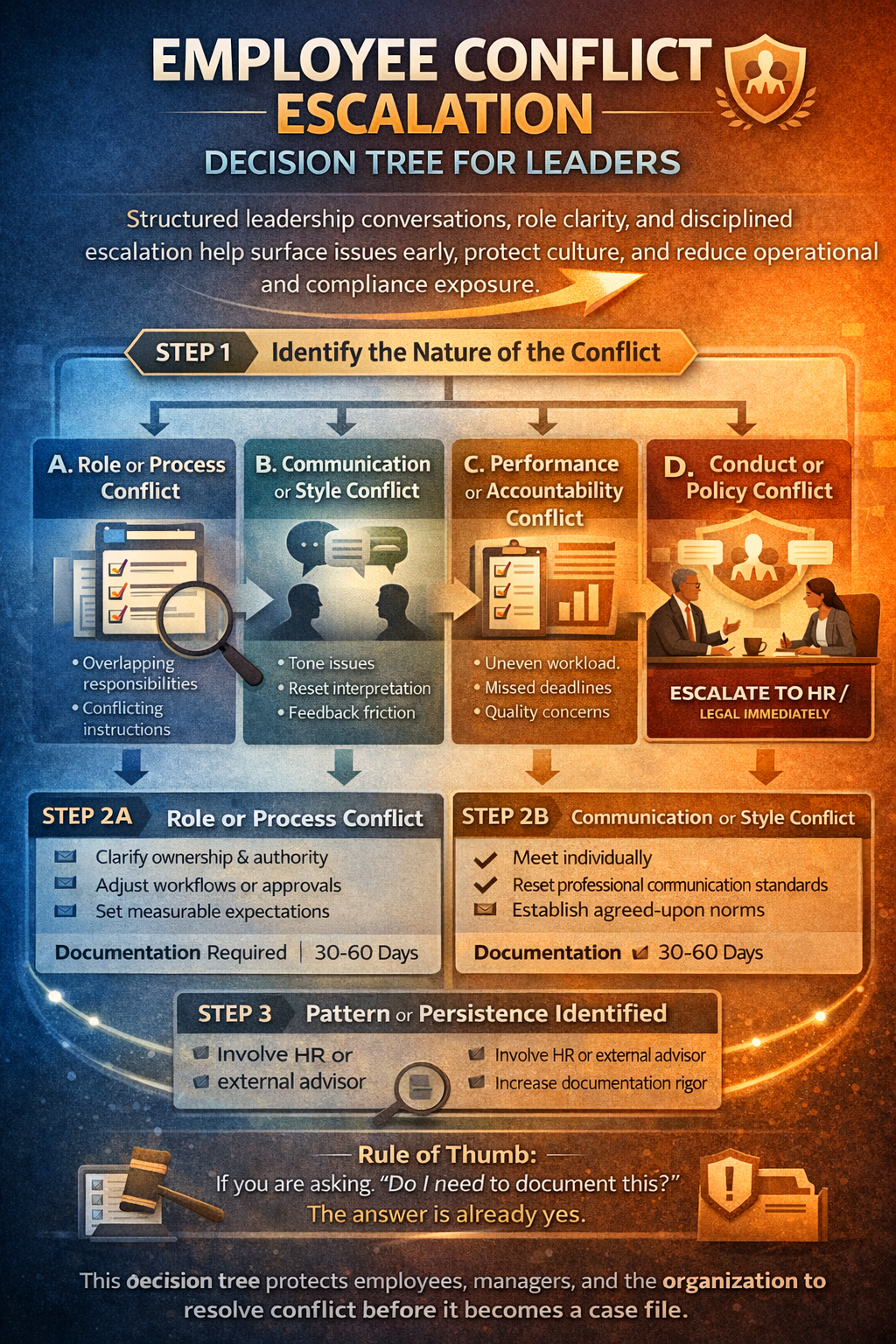
STEP 1: Identify the Nature of the Conflict
Ask first: What type of conflict is this?
A. Role or Process Conflict
Overlapping responsibilities
Conflicting instructions
Resource constraints
→ Proceed to Step 2A
B. Communication or Style Conflict
Tone issues
Misinterpretation
Feedback friction
→ Proceed to Step 2B
C. Performance or Accountability Conflict
Uneven workload
Missed deadlines
Quality concerns
→ Proceed to Step 2C
D. Conduct or Policy Conflict
Harassment concerns
Retaliation claims
Threatening or inappropriate behavior
→ Immediate escalation to HR / Legal
STEP 2A: Role or Process Conflict
Leader Action
Clarify ownership and authority in writing
Adjust workflows or approvals
Set measurable expectations
Documentation Required
Yes (role clarification summary)
Monitor
30–60 days
If unresolved → escalate to Step 3
STEP 2B: Communication or Style Conflict
Leader Action
Meet individually
Reset professional communication standards
Establish agreed-upon norms
Documentation Required
Recommended
Monitor
Behavioral consistency
If behavior repeats → escalate to Step 3
STEP 2C: Performance or Accountability Conflict
Leader Action
Clarify performance standards
Address workload imbalance
Initiate performance coaching if needed
Documentation Required
Yes
If performance does not improve → escalate to formal performance management
STEP 3: Pattern or Persistence Identified
If conflict:
Repeats
Escalates
Impacts team performance
Appears in skip-level feedback
Leader Action
Involve HR or external advisor
Implement structured intervention plan
Increase documentation rigor
STEP 4: Formal Escalation Threshold
Immediate formal escalation if:
Legal risk is present
Retaliation is alleged
Safety or harassment concerns arise
Leader neutrality is compromised
At this stage, informal handling stops.
Leadership Rule of Thumb
If you are asking:
“Do I need to document this?”
The answer is already yes.
Final Guidance for Leaders
Strong leaders do not improvise conflict management.
They follow structure.
This decision tree:
Protects employees
Protects managers
Protects the organization
And it allows conflict to be resolved before it becomes a case file.