

SPRING
A Practical Checklist for Government Contractors
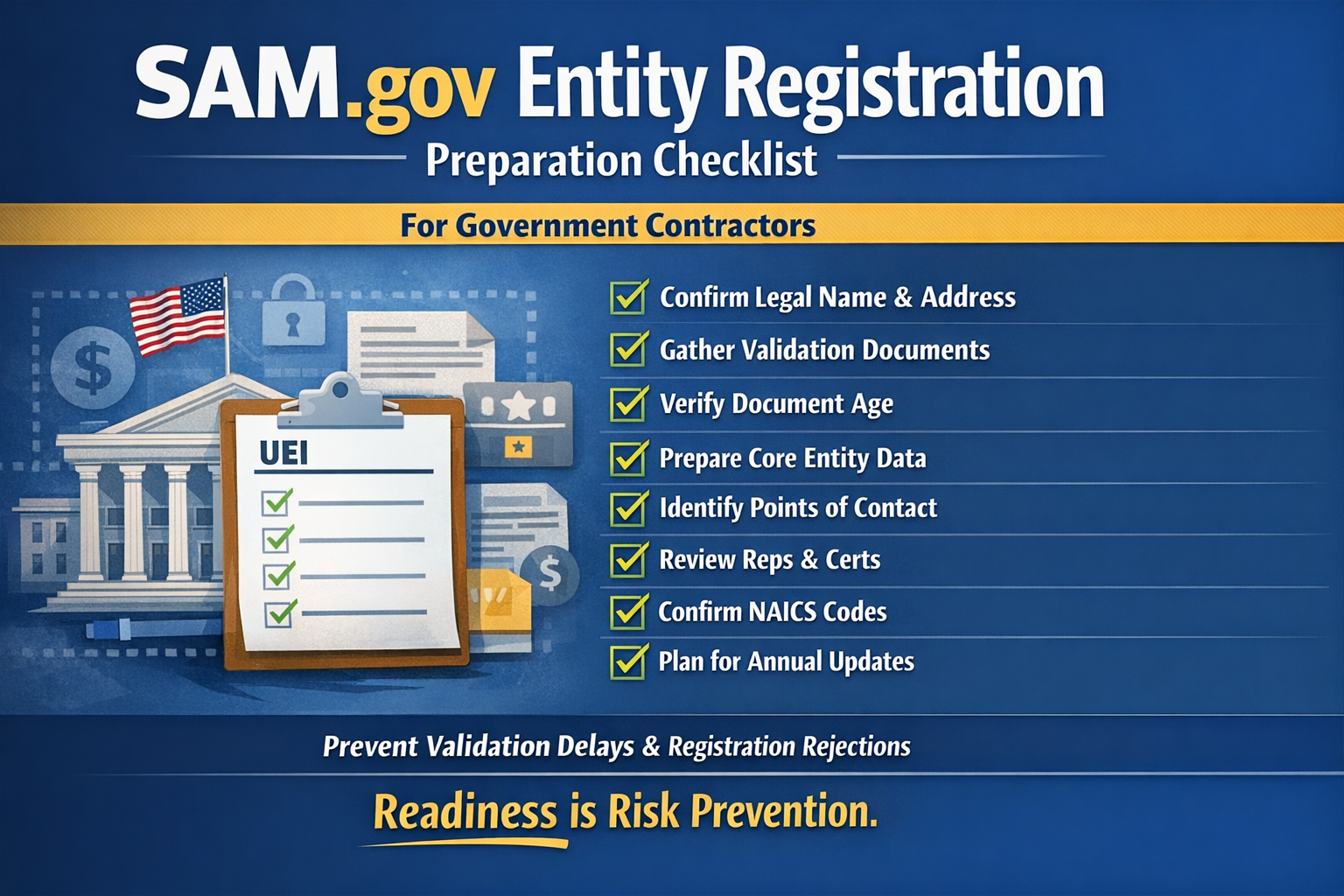
SAM.gov registration is not a single form—it is a multi-step validation process that requires accurate entity information, supporting documentation, and internal consistency across legal, tax, and operational records.
Most registration delays and rejections occur because documentation does not align with how the entity is entered in the system. Entity registration is a gatekeeping requirement for federal contracts and financial assistance. Inaccurate or incomplete submissions can result in:
Delayed activation
Failed validation
Ineligibility to bid or receive funds
These issues are rarely technical. They are usually documentation and decision-preparation issues.
How Organizations Reduce Registration Risk
Organizations that avoid registration delays treat SAM.gov preparation as a decision-stage process, not a clerical task.
Applying structured review before submission reduces failed validations, audit exposure, and lost contracting opportunities. This approach aligns with the Human Capital Risk Prevention Framework™, where governance is introduced before execution—not after rejection.
SAM.gov Entity Registration — Preparation Checklist
Step 1: Confirm How Your Entity Is Entered
Before gathering documents, confirm:
Legal business name (exact spelling, punctuation, suffixes)
Physical business address (no P.O. boxes)
Entity structure (LLC, corporation, sole proprietorship, etc.)
State and year of formation
All documentation must match these entries exactly EVS Documentation Requirements.
Step 2: Gather Entity Validation Documents (EVS)
You must submit documentation that proves:
Name and address
Start year and state of incorporation
National identifier (international entities only)
Acceptable Documentation (Most Common)
Articles of Incorporation / Organization (stamped)
Secretary of State Certificate of Filing
IRS EIN assignment letter
Current business registry screenshot (with URL)
Utility bill (water, gas, or electric only)
At least one document must show both the full legal name and physical address EVS Documentation Requirements.
Step 3: Verify Document Age and Validity
Documents marked with an asterisk (*) must be no more than five years old
All information must be current and accurate
Redact unnecessary sensitive data (bank balances, SSNs, etc.)
Outdated documents are a frequent cause of validation failure EVS Documentation Requirements.
Step 4: Prepare Core Entity Data
Before entering SAM.gov, confirm:
Date of incorporation
Fiscal year-end
Taxpayer Identification Number (TIN)
Banking information for EFT payments
CAGE or NCAGE code (or readiness to request one)
This information must be internally consistent across legal, tax, and banking records Entity Registration Checklist.
Step 5: Identify Required Points of Contact (POCs)
At minimum, prepare contact information for:
Accounts Receivable POC
Electronic Business POC
Government Business POC
These roles are used for validation, notifications, and audit communication—not just administration Entity Registration Checklist.
Step 6: Review Representations & Certifications (Reps & Certs)
Be prepared to answer questions related to:
Prior terminations for cause
Criminal, civil, or administrative proceedings
Delinquent federal taxes
Debarment or suspension history
Equal employment and affirmative action compliance
These responses are legal attestations, not administrative checkboxes Entity Registration Checklist.
Step 7: Confirm NAICS Codes and Size Metrics
Prepare:
Primary and secondary NAICS codes
Employee count
Annual receipts
Incorrect size or classification data can affect eligibility and future audits Entity Registration Checklist.
Step 8: Plan for Ongoing Maintenance
SAM.gov registrations must be renewed every 365 days
Changes to ownership, address, banking, or leadership must be updated
Validation failures can suspend eligibility without warning
Registration is not “set it and forget it” Entity Registration Checklist.
Common Mistakes This Checklist Helps Prevent
Submitting documents that don’t match system entries
Using outdated or expired documentation
Treating Reps & Certs as administrative rather than legal
Fragmenting responsibility across HR, finance, and operations
Waiting until a bid deadline to address validation issues