

SPRING
Readiness Checklist for Executives and Founders
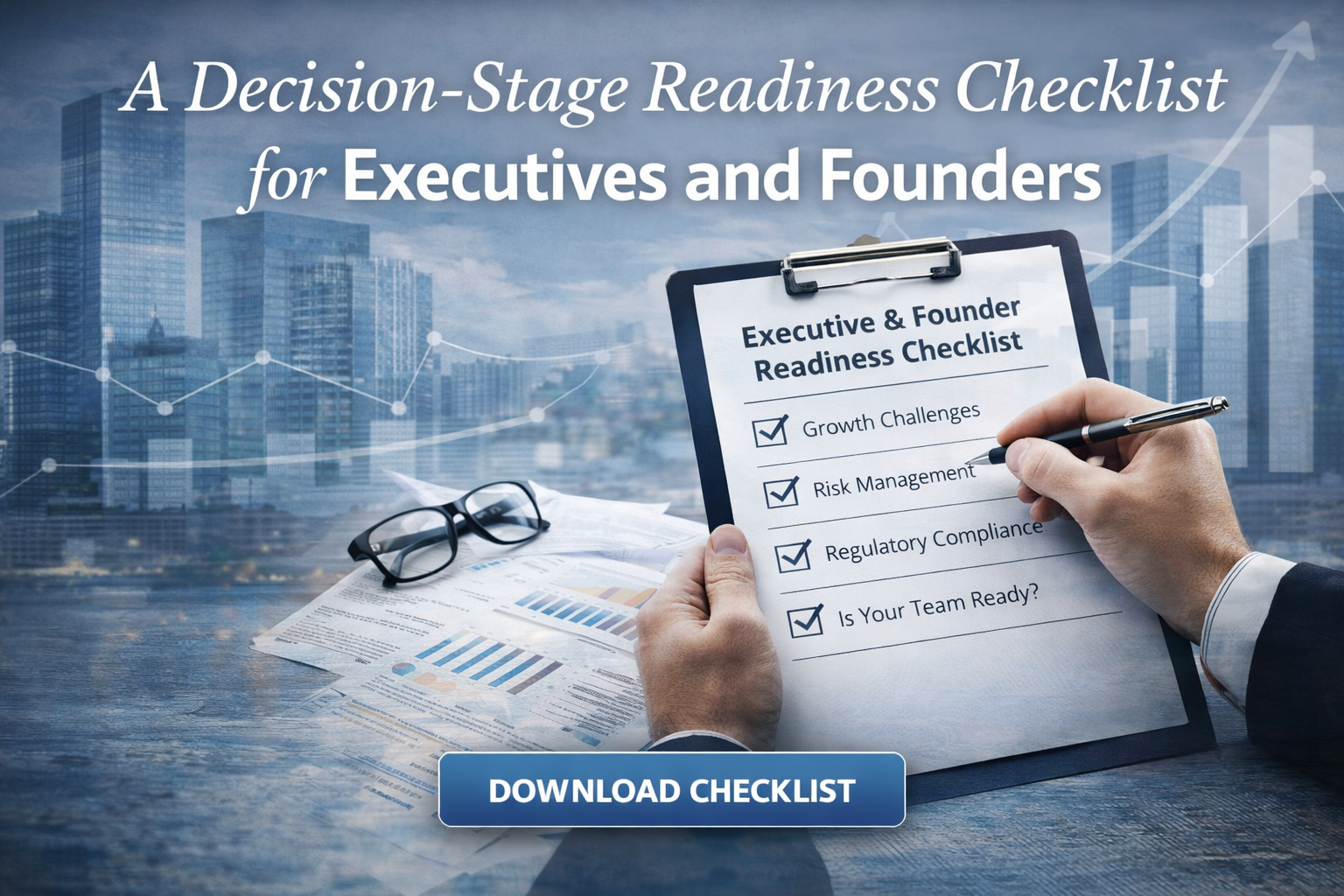
Before making major organizational decisions—scaling, restructuring, entering regulated markets, or addressing internal strain—leaders must assess whether their people systems are actually ready. Most risk does not come from the decision itself. It comes from making decisions on top of misaligned leadership, unclear accountability, or fragile workforce infrastructure.
This checklist is designed to help executives and founders evaluate human capital readiness before committing to high-impact decisions.
What Is Decision-Stage Readiness?
Decision-stage readiness is the organization’s ability to execute strategic decisions without creating unnecessary legal, operational, or leadership risk. It reflects whether people systems, governance, and accountability structures can support what leadership is about to ask of the organization.
If readiness is low, even the right decision can destabilize the business.
Executive & Founder Readiness Checklist
Use this checklist to assess whether your organization is prepared for its next decision stage.
1. Leadership Alignment & Authority
☐ Decision-making authority is clearly defined and understood
☐ Leadership roles and expectations are documented and enforced
☐ There is alignment between owners, executives, and senior leadership
☐ Leaders are spending time on strategy—not resolving recurring people issues
Why this matters:
Misaligned leadership creates downstream conflict, delays, and credibility loss. Strategy cannot outpace governance.
2. Organizational Structure & Accountability
☐ Roles and responsibilities are clearly defined across teams
☐ Reporting lines reflect how work is actually done
☐ Accountability is consistent—not personality-driven
☐ Performance issues are addressed structurally, not emotionally
Why this matters:
When structure is unclear, risk hides in ambiguity. People problems repeat because the system allows them to.
3. Workforce Classification & Compliance
☐ Worker classifications (W-2, 1099, exempt/non-exempt) are accurate
☐ Policies and practices align with current labor standards
☐ Documentation exists—and matches reality
☐ Compliance is proactive, not audit-driven
Why this matters:
Compliance failures rarely announce themselves. They surface during growth, disputes, audits, or exits—when correction is most expensive.
4. People Operations Infrastructure
☐ Payroll, benefits, and HR systems are accurate and scalable
☐ Processes are consistent across departments or entities
☐ Data supports decision-making, not just administration
☐ Operational ownership is clear
Why this matters:
Operational gaps turn strategic decisions into execution failures. Systems must support scale, not just survive it.
5. Risk Exposure & Escalation Pathways
☐ There is a clear process for handling complaints or disputes
☐ Leadership knows when and how issues escalate
☐ Conflict is addressed early, not deferred
☐ External risk (legal, regulatory, reputational) is actively monitored
Why this matters:
Unmanaged conflict becomes enterprise risk. Silence is not stability.
6. Change Readiness & Execution Capacity
☐ The organization has successfully navigated change before
☐ Communication channels are trusted and effective
☐ Leaders are prepared to enforce new expectations
☐ Change is planned—not reactive
Why this matters:
Organizations fail change initiatives not because of resistance, but because readiness was assumed instead of assessed.
How to Interpret Your Results
Mostly checked: Your organization likely has the foundation to support strategic decisions.
Several unchecked: Decision-stage risk is present. Progress without correction will increase exposure.
Many unchecked: Pause. Strategic decisions made now will likely create instability, conflict, or compliance risk.
This is not about perfection. It is about knowing where structure is required before pressure is applied.
When to Seek Human Capital Strategy Support
Organizations benefit most from human capital strategy support when:
Growth is accelerating faster than systems
Leadership transitions are underway
Compliance exposure is increasing
Internal conflict or operational drag is consuming executive time
At this stage, clarity matters more than speed.
Key Takeaway
Strong organizations do not guess their readiness. They design it.
Decision-stage readiness is not an HR exercise. It is an executive responsibility that protects performance, leadership credibility, and long-term enterprise value.