Why Human Capital Strategy Is Where Revenue Is Won or Lost
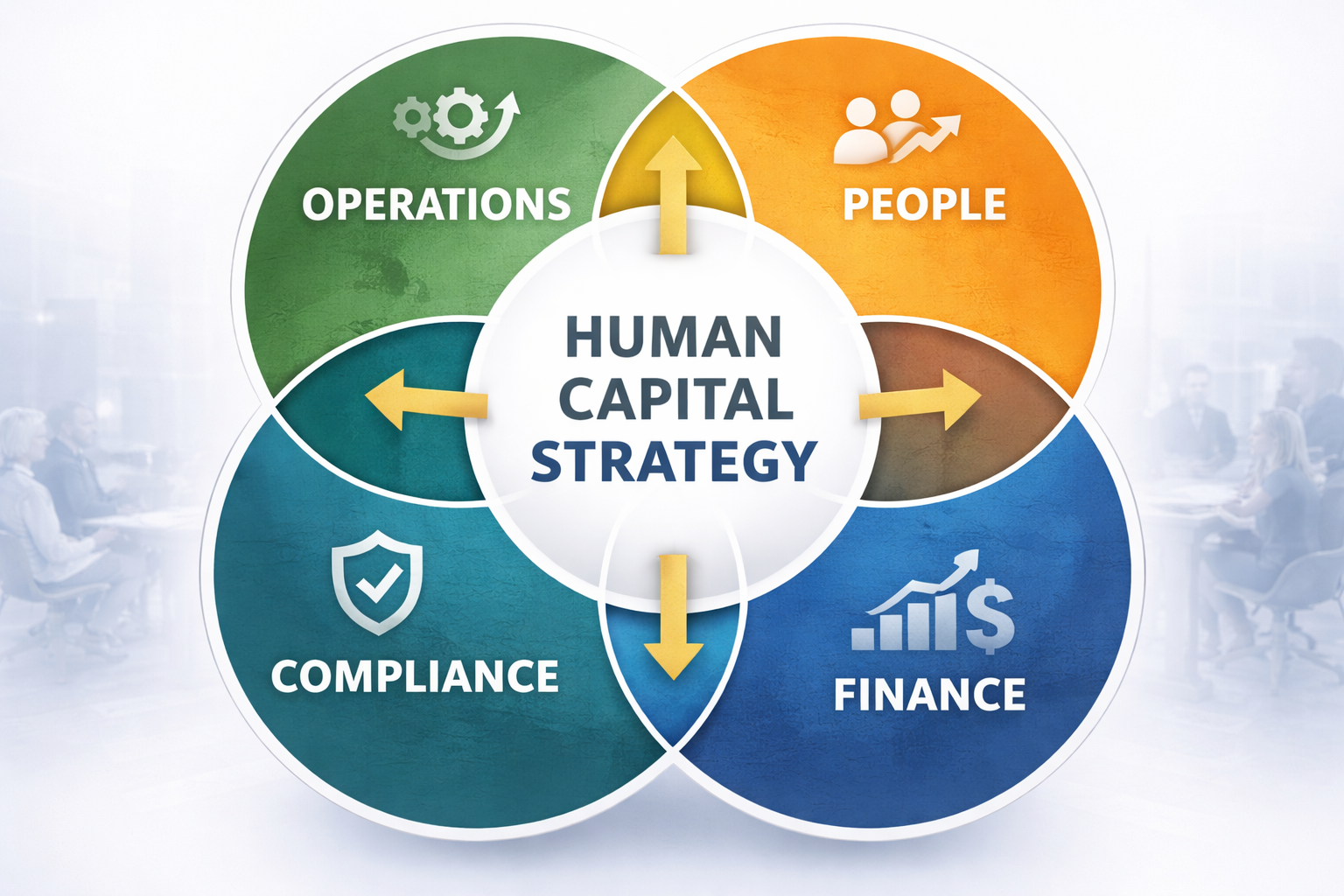
Visual framework depicting human capital strategy where operations, people management, compliance, and financial planning intersect to support organizational alignment, leadership execution, and sustainable business growth.
Every January, I see the same pattern.
Leaders reset goals. Revenue targets go up. Headcount plans get discussed.
And underneath it all, the systems that actually make execution possible remain misaligned.
That is not a motivation problem.
It is not a leadership problem.
It is a systems problem.
Revenue does not grow in isolation. It grows at the intersection of operations, people, compliance, and finance. When those four are not aligned, growth becomes fragile—and expensive.
Revenue Doesn’t Come From Selling Harder
Most organizations treat revenue as a sales outcome. I don’t.
Revenue is the byproduct of an organization’s ability to execute consistently, at scale, without leadership burning out or compliance creating drag.
When operations are inefficient, people compensate.
When people systems are unclear, managers react.
When compliance is reactive, leadership gets distracted.
When finance is disconnected from workforce reality, plans fail in execution.
You don’t fix that with another initiative.
You fix it with structure.
What January Exposes for Most Businesses
January is when human capital obligations reset—quietly.
Wages. Policies. Benefits. Performance expectations. Reporting requirements. Workforce planning assumptions.
In large organizations, these are handled by entire teams. In small and mid-sized businesses, they usually land on one or two leaders already carrying too much.
That’s where I see the breakdown. Not because leaders don’t care—but because the business has outgrown informal decision-making.
This isn’t an HR issue.
It’s an operating model issue.
Why I Built the Human Capital Strategy Session
I built the Human Capital Strategy Session because most businesses don’t need more advice. They need alignment—and an executable plan.
This is not a training.
It is not a generic assessment.
It is not theory.
It is a working session that looks directly at how your organization actually functions across four areas:
Operations – how work flows, where friction lives, and what limits scale
People – role clarity, leadership capacity, performance expectations
Compliance – real risk exposure versus what leadership assumes
Finance – labor costs, productivity, and revenue alignment
The outcome is not a report that sits on a shelf.
It is a roadmap leadership can act on immediately.
Fortune 500 Thinking, Applied Practically
Large organizations solve these problems with layers of experts. Most growing businesses don’t have that luxury.
My work brings Fortune 500–level human capital, operational, and compliance thinking into small and mid-sized businesses—without the overhead, and without the bureaucracy.
At KS Consulting, we design systems that hold under pressure. Systems that reduce noise, protect leadership bandwidth, and support revenue growth instead of working against it.
Where Revenue Is Leaking (And Most Leaders Don’t See It)
Revenue loss rarely shows up as a single failure. It shows up as friction:
Managers constantly firefighting
Roles that no longer match the business model
Compliance concerns that create hesitation or delay
Labor costs rising without productivity gains
When these are addressed at the system level, something important happens: capacity is restored. That capacity can be redirected into growth, strategy, and execution.
Human Capital Is Not a One-Time Decision
This is the part most organizations miss.
Human capital is not a once-a-year exercise. Regulations change. Teams evolve. Strategy shifts. If the system doesn’t adapt, it breaks.
Organizations that scale well treat people, operations, compliance, and finance as a living system—one that is reviewed, adjusted, and reinforced throughout the year.
That is what the Human Capital Strategy Session is designed to establish.
Clarity Is the Advantage
If January already feels heavy, that’s not a failure.
It’s a signal.
It means the business has reached a point where clarity matters more than hustle, and structure matters more than effort.
I don’t help organizations guess.
I help them design systems that last.
That’s where execution stabilizes.
That’s where leadership gets lighter.
And that’s where revenue finally has room to grow.