New IRS Rules for Employer-Paid PFML Contributions Take Effect in 2026
Employer-Paid PFML Contributions Are Now Taxable Wages — Here’s What That Means
Starting with the 2026 tax year, new IRS guidance changes how employer-paid Paid Family and Medical Leave (PFML) contributions must be treated for federal tax purposes.
Under IRS Revenue Ruling 2025-4, when an employer voluntarily pays an employee’s share of PFML taxes, those amounts must now be included in the employee’s federal taxable wages.
This rule applies regardless of whether the employee receives additional take-home pay.
What Changed Under IRS Revenue Ruling 2025-4
Beginning in 2026:
Employer-paid employee PFML contributions are taxable income
These amounts must be included in Box 1 of the employee’s W-2
Taxes must be calculated accordingly, even though no extra cash is paid to the employee
This creates a distinction between taxable vs. payable compensation, which must be handled precisely within payroll systems.
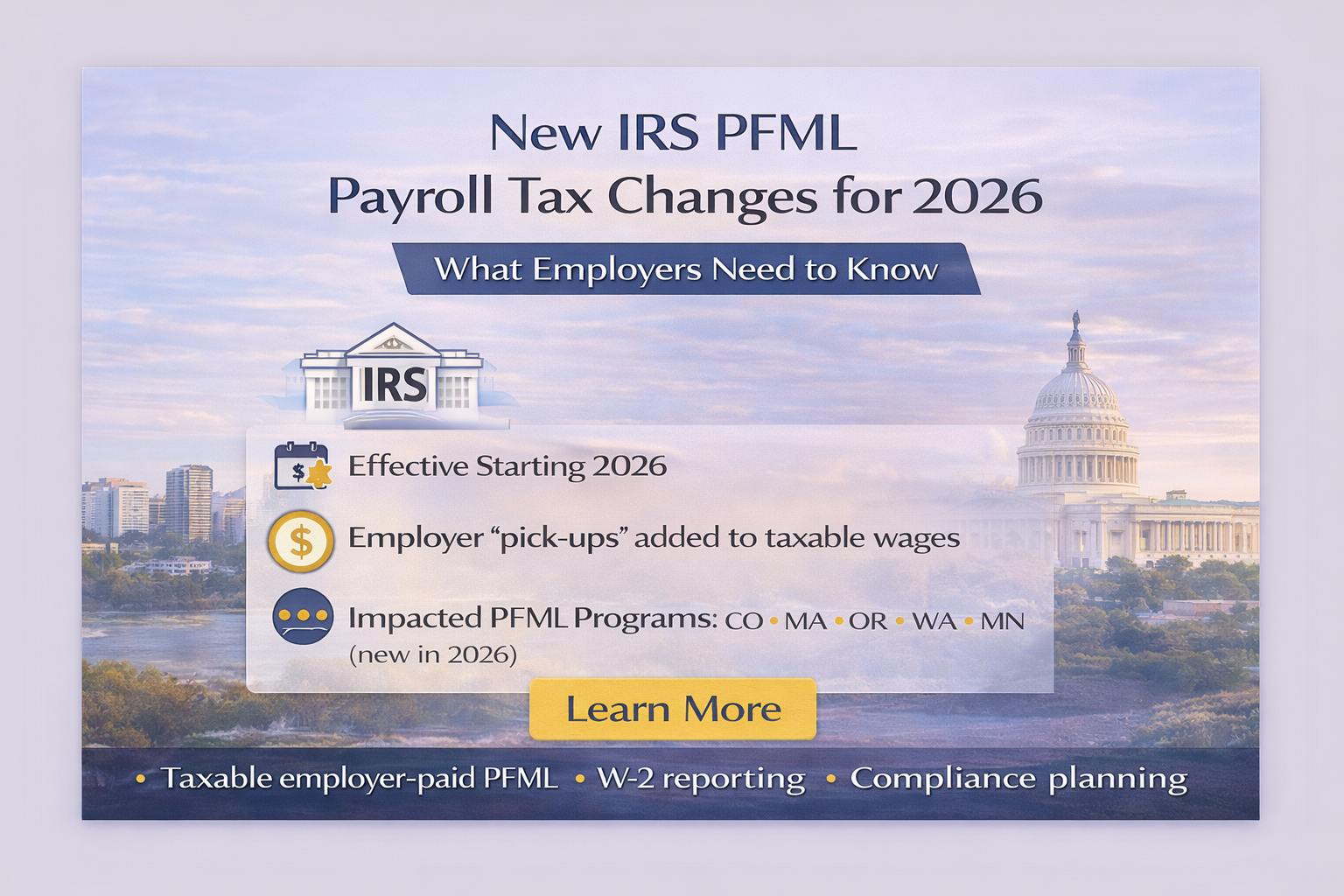
New IRS payroll tax rules effective in 2026 requiring employer-paid PFML contributions to be included as taxable wages, highlighting compliance and reporting considerations for employers.
States Impacted by This IRS Change
The employer contribution “pick-up” rule applies to PFML programs in:
Colorado
Massachusetts
Oregon
Washington
Minnesota (new in 2026)
PFML programs not impacted by this IRS change include:
Connecticut
Delaware
District of Columbia
Maine
New Jersey
New York
For multi-state employers, this distinction is critical.
Why This Matters Operationally
Without proper payroll configuration, organizations risk:
Under-reporting taxable wages
Incorrect W-2 reporting
Payroll tax discrepancies
Employee confusion over pay statements
Increased audit exposure
This is not simply a tax update—it is a payroll architecture issue.
Building Compliance Into Payroll Systems
Rather than relying on workarounds, consulting support ensures that payroll software is configured to:
Properly classify employer-paid PFML contributions
Apply correct tax treatment automatically
Reflect contributions clearly on pay statements
Maintain compliance across multiple PFML jurisdictions
When built correctly, payroll runs remain seamless—even as tax rules grow more complex.
A Broader Human Capital Perspective
These IRS changes highlight a larger trend: payroll and tax compliance are no longer siloed administrative tasks. They sit at the intersection of human capital strategy, financial governance, and risk management.
Organizations that treat compliance as a system—rather than a series of fixes—are far better positioned to scale without disruption.
Disclaimer: This content is informational only and does not constitute legal or tax advice. Employers should consult legal and tax professionals regarding compliance.